The Gate Mistake That Gets Flagged After Installation
A surprising number of HDB gate replacements go wrong after the fact, not before. Homeowners pick a gate based on looks and budget, order it, and only discover once it's fitted, or worse, once a neighbour or town council flags it, that the swing direction blocks the corridor, or the clearance from a staircase railing falls short. At that point, the options are limited and expensive: modify the gate, or remove it and start again. You can avoid almost all of this by understanding a handful of HDB gate rules before ordering, not after.
Do You Need a Permit to Replace Your HDB Gate?
For most homeowners, the answer is reassuring: replacing your main entrance gate generally does not require an HDB permit, provided the new gate keeps the same width, the same number of panels, and swings in the same direction as the one originally provided. This like-for-like condition is what keeps the replacement permit-free. It's a genuinely helpful exemption, since you can start permit-free work as soon as you've chosen a compliant gate, without waiting for an approval process.
When a Permit Is Required Instead
The permit-free path only covers a straightforward swap. If the work goes further, changing the size or shape of the opening, widening the entrance, or altering structural elements around the doorway, you move into permit-required territory, and structural changes of this kind are rarely approved. Separately, some HDB units along a fire escape route have specific requirements for the main door and frame (not the gate itself) under a different set of rules. If you're unsure whether your planned work is a simple gate swap or something more involved, check current HDB renovation guidance for your specific block before committing to a design.
Matching Your Original Gate Specifications

The like-for-like principle sounds simple, but it trips people up more often than expected. Width, panel count, and swing direction all need to match the original HDB-provided gate, not just approximately, but as a genuine condition of staying permit-free. Homeowners sometimes assume these are flexible details they can adjust for a better fit with their door or a preferred aesthetic. In practice, changing any of them shifts the replacement out of the permit-free category and into a compliance grey area that can result in the gate being flagged after the fact.
Why You Can't Simply Switch Swing Direction
Swing direction isn't a cosmetic preference, even though it's often treated as one. A gate that originally swung inward but gets replaced with one that swings outward, or vice versa, can obstruct a neighbour's door, block the corridor, or interfere with a clear path to the staircase during an emergency. This is a safety rule, not a styling one, which is why it's enforced regardless of how much better the alternative swing might look or function day to day.
Corridor Clearance Requirements for Common-Corridor Units

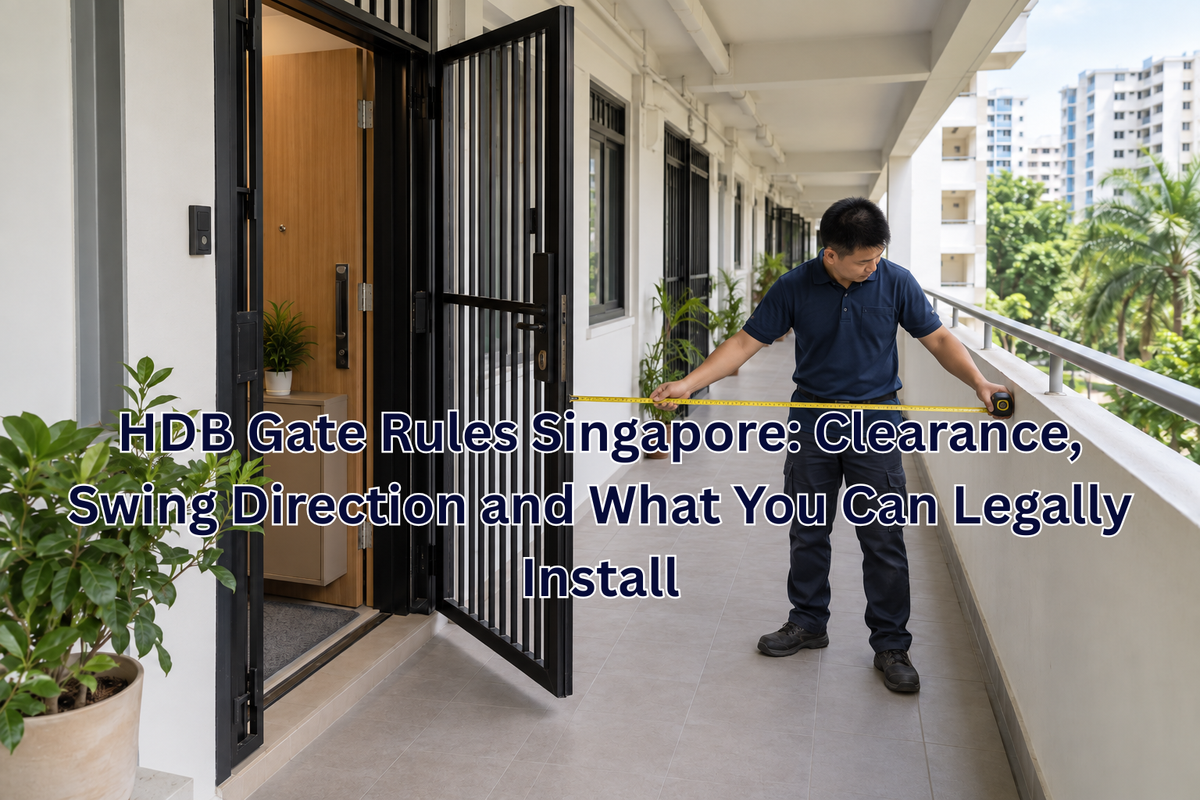
If your unit sits along a common corridor, there's a specific clearance requirement between your fully open gate and the corridor's parapet wall. This is commonly cited as a minimum of 0.6 metres when the gate opens perpendicular to the parapet wall, though you should confirm the exact figure against current HDB guidance for your block before finalising a design, since this is precisely the kind of safety-critical detail worth double-checking. The purpose is straightforward: in an emergency, neighbours and residents need an unobstructed path past your door to reach the stairs.
How to Check Whether Your Gate Design Meets Clearance
Rather than estimating clearance from a gate's listed dimensions on a product page, measure the fully open swing radius against your actual corridor width on site. Corridor widths aren't always perfectly uniform across a block, and a design that would technically clear a wider corridor elsewhere in the estate might not clear yours. A brief on-site check before fabrication avoids finding out the hard way after the gate has already been made.
Special Clearance Rules for Units Near Staircases

Units next to a staircase face a stricter and different rule from the standard corridor clearance. Rather than a fixed distance, the required clearance from the edge of the gate, measured when it's open at any angle, to the staircase railing must be equivalent to the width of the staircase itself. This trips people up because it's easy to assume the same clearance figure applies everywhere, when in fact staircase-adjacent units are held to a different, stair-width-based standard. If your unit falls into this category, measure the staircase width directly rather than assuming a standard number applies.
Corner Units and Neighbour-Facing Considerations
Corner units carry their own consideration: gate swing must not strike a neighbouring unit's window or door. This is easy to overlook when focused on corridor or staircase clearance, since a corner unit's gate swing path is often unique to its position relative to the neighbouring flat. Corner units generally need more careful gate selection than mid-row units precisely because there's an additional obstacle in the swing path that a standard clearance check doesn't automatically cover.
What You Can Legally Choose: Materials, Panel Styles and Locks

None of this means a compliant gate has to look generic. Within the width, panel count, and swing constraints described above, you still have real choice: material (mild steel, wrought iron, stainless steel, or aluminium), finish and colour, mesh versus bar designs, and how open or private the gate feels. Compliance defines the envelope; it doesn't dictate the design inside it.
Fitting a Digital Lock Without Compromising Compliance
Smart lock integration is generally permitted on HDB gates, as long as fitting it doesn't alter the gate's approved dimensions, swing direction, or structural fixing points. In practice, this mostly comes down to whether the gate's frame and bar layout can accommodate the lock's mounting plate cleanly. Confirm compatibility between your chosen digital lock and the specific gate profile before ordering, since retrofitting a lock onto an incompatible design after the fact is more disruptive than checking upfront.
What Happens If Your Gate Doesn't Comply
A non-compliant gate, whether it's the wrong swing direction, insufficient clearance, or a mismatched width, can be flagged after installation and result in a rectification order requiring you to modify or replace it at your own cost. This isn't meant to alarm; it's simply the practical reason these details are worth checking against your specific unit before fabrication rather than after installation, when correcting the issue is considerably more disruptive and expensive.
Steps to Take Before You Order a Replacement Gate
Before committing to a design, it helps to work through your unit's specific situation rather than assuming general rules apply uniformly.
|
Your Unit's Position |
What to Check Before Ordering |
|
Along a common corridor |
Fully open gate maintains the required clearance from the corridor parapet wall |
|
Adjacent to a staircase |
Clearance from gate edge to staircase railing matches the staircase's width |
|
Corner unit |
Gate swing doesn't strike a neighbouring unit's window or door |
|
Any unit |
New gate matches original width, panel count, and swing direction |
Measure your existing gate and its swing path, confirm current HDB guidelines for your specific flat type and block, and check whether your unit's position triggers any of the additional rules above. SG Aluminium is an HDB- and BCA-licensed Singapore contractor that homeowners can consult to confirm a gate design meets these requirements before ordering, mentioned here as an illustrative reference rather than a recommendation. The same verification is worth doing with any supplier you're considering, and HDB's own directory lets you confirm a contractor's registration status directly.
Questions Worth Asking Before Fabrication
A short set of questions before you commit to a design can prevent most compliance issues:
- Can you confirm my gate's swing direction matches the original before fabrication?
- Does the panel count and width match what HDB originally provided for my unit?
- Will you measure my corridor or staircase clearance on site before ordering?
- Does this design remain compliant if I later add a digital lock?
These questions apply to any gate supplier, not one particular company, and asking them upfront is what actually prevents the post-installation problems described earlier.
Conclusion
Replacing an HDB gate is refreshingly permit-free for most homeowners, as long as the new gate matches the original in width, panel count, and swing direction. Beyond that baseline, the rules that matter most depend on where your unit sits: corridor clearance for common-corridor units, a stricter stair-width-based clearance for staircase-adjacent units, and a neighbour-facing check for corner units. None of these rules restricts your choice of material, finish, or lock, only the dimensions and swing path that keep corridors and escape routes clear. Verifying these specifics against your own unit and current HDB guidance before you order is what separates a smooth replacement from a costly rework.