Why Bathroom Cabinet Material Choice Matters More Than It Seems
Most homeowners choose a bathroom basin cabinet the way they'd choose any piece of furniture: by looks and price. Material tends to be an afterthought, if it's considered at all. That's an easy mistake to make with a laminate or wood-veneer cabinet in a bathroom, and it's also the mistake that shows up a year or two later as swollen board, peeling edges, or a musty smell that won't go away. Singapore's bathrooms are small, humid, and in near-constant contact with water, which makes material a genuine functional decision here, not a cosmetic one. An aluminium basin cabinet is one alternative worth understanding in Singapore's bathroom conditions before you commit to a cabinet you'll be looking at, and dealing with, for years.
What Is an Aluminium Basin Cabinet?

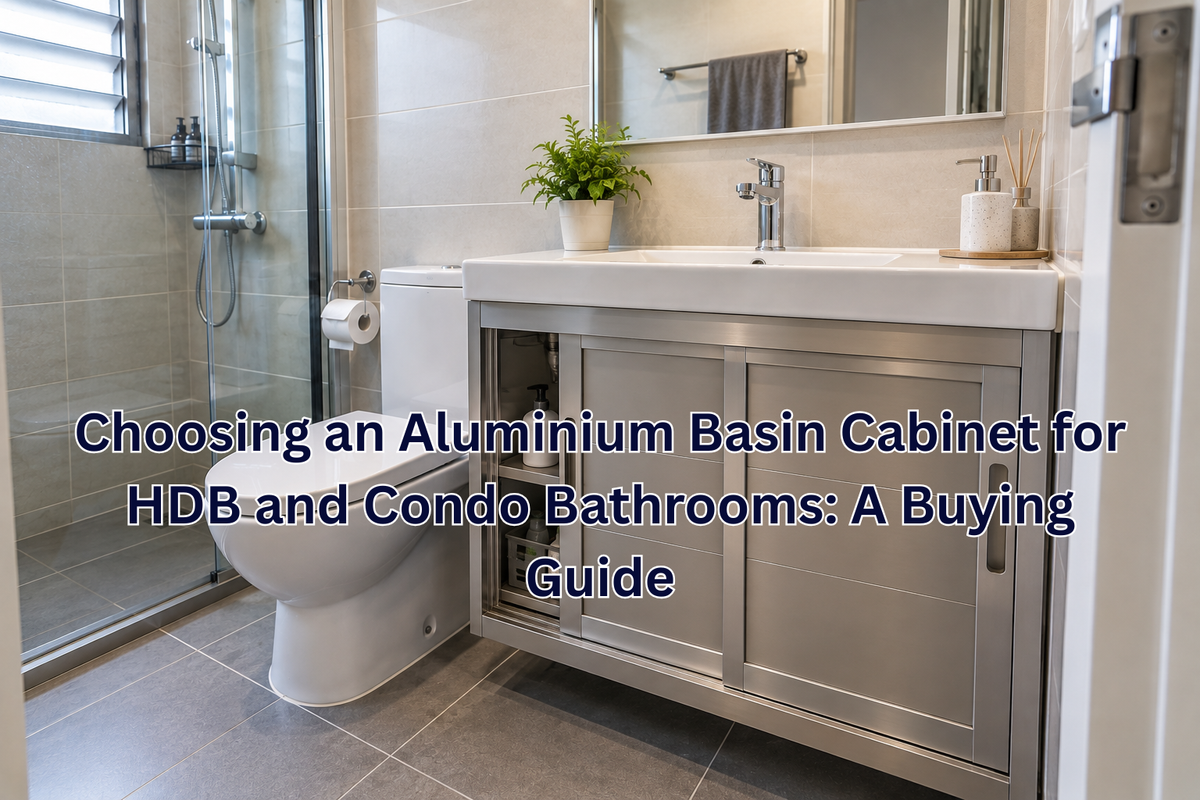
An aluminium basin cabinet uses an aluminium frame, together with a sliding or swing door, built around the basin or vanity area of a bathroom. This sets it apart from cabinets built from laminated MDF, PVC, or solid wood, which rely on a board or timber core that behaves very differently when repeatedly exposed to moisture. The aluminium element is typically the frame and door structure; what sits behind or beneath it- the basin itself, plumbing, and countertop- is a separate consideration depending on what your bathroom already has or what you're sourcing alongside it.
Sliding vs Swing Basin Cabinet Doors

The two common door configurations each suit a different kind of bathroom. Sliding doors are the practical choice in a space-constrained bathroom, since they don't need floor clearance to open, which matters when a toilet, shower screen, or narrow walkway sits close to the cabinet. Swing doors need that clearance, but they offer fuller, easier access to what's stored inside, without the partial obstruction a sliding track can create. Neither is objectively better; it comes down to how much floor space your bathroom actually gives you around the cabinet.
Why Aluminium Performs Well in Wet Bathroom Environments
Aluminium doesn't absorb water the way MDF, chipboard, or untreated timber does, so it doesn't swell, warp, or delaminate from repeated exposure to splashes and humidity. It also naturally forms a thin oxide layer on its surface that resists corrosion, a property well documented in materials chemistry; powder-coated or anodised finishes, commonly used on aluminium furniture, build on this further. This matters more in a Singapore bathroom than it might elsewhere, given the combination of high ambient humidity and a small, often poorly ventilated room. The World Health Organization's guidance on indoor dampness and mould notes that material selection is one of the practical ways to limit moisture penetration and mould growth on interior surfaces, which is exactly the mechanism at play with a wet-area cabinet.
How Aluminium Compares to Laminate, PVC and Solid Wood Cabinets
No material is without trade-offs, and the right choice depends on what you're prioritising. Here's how the common options compare on the factors that matter most for a bathroom purchase:
|
Material |
Moisture Resistance |
Maintenance |
Typical Price Positioning |
|
Aluminium |
Strong; doesn't absorb water or warp |
Low; wipes clean, no resealing needed |
Mid to higher range |
|
Laminate/MDF |
Weak; prone to swelling at joints and edges over time |
Moderate; edges need monitoring for water ingress |
Lower range |
|
PVC |
Good; naturally water resistant |
Low |
Lower to mid range |
|
Solid wood |
Weak unless heavily treated and sealed |
High; requires ongoing sealing and care |
Higher range |
This is a general guide rather than a precise ranking, since actual product quality varies significantly within each material category. A well-made PVC cabinet can outperform a poorly finished aluminium one, and the reverse is equally true.
Sizing an Aluminium Basin Cabinet for HDB and Condo Bathrooms
Singapore bathrooms, particularly in HDB flats, are compact by international standards, often just a few square metres including the shower and toilet area. This means cabinet width, depth, and the door's swing or slide path must match your actual bathroom footprint, not a generic size chart that assumes more floor space than you have.
Measuring Your Bathroom Before You Order
Before ordering, measure the available wall width where the cabinet will sit, the clearance from the edge of the basin or counter to the nearest fixture, and the full swing or slide path of the door itself. Also check proximity to other fixtures, a shower screen, the toilet, or a narrow doorway that could obstruct the cabinet door even if the cabinet itself fits the wall space. It's easy to measure the wall and assume that's enough; the door's operating path is often the real constraint in a small bathroom.
Waterproofing and Water Resistance Considerations
A basin cabinet sits in one of the wettest parts of the home, so construction quality matters more here than it would for, say, a bedroom wardrobe. Sealed joints prevent water from working its way into gaps over time; water-resistant fittings and hardware avoid the corrosion that ordinary hardware would suffer in a damp environment; and some consideration for splash drainage, so water doesn't pool at the base of the cabinet, helps prevent long-term staining or damage at the point where the cabinet meets the floor. These details are easy to overlook when comparing cabinets on finish and price alone, but they're a large part of what separates a cabinet that lasts from one that needs replacing within a few years.
Hardware, Fittings and Finish Options

Within the aluminium frame itself, there's real room for choice: handle styles, hinge or sliding-track quality, and a range of finish and colour options. Track and hinge quality in particular affects how the cabinet feels day to day: a well-made sliding mechanism should move smoothly for years, while a poor one can start sticking or rattling within months of everyday use.
Matching Your Basin Cabinet to the Rest of the Bathroom
If you're renovating the bathroom as a whole rather than replacing a single fixture, it's worth coordinating your basin cabinet's finish with other aluminium fixtures in the space, a shower screen frame, for instance, so the room reads as a considered design rather than a set of mismatched replacements bought at different times.
Common Mistakes When Choosing a Basin Cabinet
A few practical pitfalls come up repeatedly. The most common is underestimating door-swing clearance in a small bathroom: a cabinet that looks fine on a floor plan can collide with the toilet or a half-open shower screen door in practice. Choosing a finish that clashes with existing fixtures is another: easy to overlook when shopping from a catalogue rather than standing in the actual room. And overlooking existing plumbing points, the basin tap, waste pipe, or water inlet, can mean a cabinet that looks right but doesn't actually fit around what's already installed.
Installation Considerations Before You Order
Compared with window or door replacement, basin cabinet installation is generally more contained, but it still benefits from accurate on-site measurement rather than relying on listed dimensions alone. Before ordering, confirm that the cabinet is compatible with your existing basin and tap setup, particularly if you're keeping the current plumbing rather than replacing it as part of the same renovation. SG Aluminium is a Singapore supplier offering aluminium-framed sliding and swing basin cabinet doors, mentioned here as an illustrative reference rather than a recommendation; the same plumbing and clearance checks apply regardless of which supplier you're considering.
Questions to Ask Before Purchasing
A short set of questions can help you compare suppliers on the details that actually matter:
- What door mechanism options are available, and which suits my bathroom's layout?
- What warranty applies to the hardware, hinges, or tracks specifically?
- How does the finish hold up to prolonged wet conditions over time?
- What is the current lead time from order to installation?
These apply to any supplier you're comparing, not one in particular.
Conclusion
An aluminium basin cabinet is a genuinely practical option for Singapore's humid, compact bathrooms, largely because the material itself doesn't share the moisture-related weaknesses of laminate, MDF, or untreated wood. Getting the decision right comes down to a handful of practical factors: sizing the cabinet and its door path to your actual bathroom footprint, checking construction quality around sealing and hardware, and confirming compatibility with your existing plumbing before you order. None of this makes the choice complicated, but it does mean treating it as a material decision rather than a purely visual one, which is where most of the long-term satisfaction, or regret, with a bathroom cabinet actually comes from.